Portal for tuvinology

Tuva.Asia / The New Research of Tuva

Russian version/Русская версия
Сегодня 12 June 2026 г.
Home |
29 October 2011

Tuvans in China (No.2)

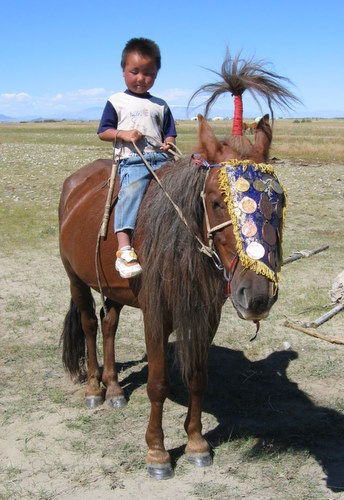
Tuvans in China  (No.2)They were permitted to go back to their original lands only in 1982. They had to start all over again, to clear the pastures, to teach their children herding skills. That was 29 years ago. It is a short time span in the life of a nation, but the Tuvans managed to re-establish much during that time.

In the place of Honor  - Flag and heraldic crest of their Historical Homeland

To this day, they keep the customs of  their ancestors regarding introductions. Meeting a guest, they always ask from which tribe and clan he is, and his age. A person's age is very important for the carriers of the traditions - it serves to determine the etiquette of behavior with the stranger.

Because of the predominance of other language populations in the places where the Tuvans live, their language has many words borrowed from Kazakh, Mongolian, and Chinese languages. It shows, in particular, in the phonetic and lexical peculiarities of their daily speech. 
Zhanna Yusha. Tuvinskaya Pravda. Translated by Heda Jindrak
  • 0 comments
  • 100
 
21 October 2011

Tuvans in China

Tuvans in ChinaTuvans in China live in the Altai aimak of Xinjiang -Uighur autonomous region of Chinese People's Republic, in picturesque mountains and steppes of the Altai Mountains. This territory borders in the north with Russia, in the west - Kazakhstan, and  east - with Mongolia.

Representatives of various ethnic backgrounds mingle in the Altai aimak: Chinese, Kazakhs, Dunkans, Mongols, Uighurs. Many Kazakhs can be counted in the compact Tuvan settlements (Ak-Khaba, Khanas, Khom, Ala-Khaak, Kok-Dogai). Tuvan families also live in towns Altai, Burchin, and Khaba.

Igor Irgit, who was the head of State committee for foreign economic connections at the time, was the first one to visit the Chinese Tuvans in 1992, and Marina Mongush, the scholar - ethnographer, visited them in1993.

Zhanna Yusha, Tuvinskaya pravda. Translated by Heda Jindrak
  • 0 comments
  • 80
 
19 October 2011

New National Anthem of Tuva discussed on radio "Svoboda"

New National Anthem of Tuva discussed on radio "Svoboda"New National Anthem of Tuva discussed on radio "Svoboda"Irina Lachugina: on 11 August of this year, the Supreme khural of Republic Tuva adopted a new national anthem of the republic. Its name is "I am a Tuvan".  The translation is: "I am a Tuvan, Son of eternally white mountaintops, I am a Tuvan,, Daughter of the land of silver rivers." And on Monday, the mayor of Kyzyl refused to hold a meeting of protest against this anthem. Tuvan intellectuals believe that the anthem not only has nationalistic hues, but that it was adopted illegally as well. On top of that, it is an ordinary song of Tuvans of Mongolia, was not composed on Tuvan territory, and as such it does not qualify as an official anthem of the republic,  in the opinion of the organizers of the meeting. We continue our series of discussions "Ethnic map of Russia". Today the topic is Tuvans. The participants in the discussion are head of  Caucasus department of RAN institute of ethnology, professor Sergei Arutyunov and Doctor of historical sciences, chief scientific worker of Tuvan Institute of Humanitarian Research, Marina Mongush.
Translated by Heda Jindrak
  • 0 comments
  • 100
 
19 October 2011

Know your Menge

 Know your MengeMenge is a birth mark, a special sign that every person has. It has a certain degree of influence on a person's health, spirit, body, mind and character. The astrological Menge is not a birth mark on a person's body, on the face, etc. it is an abstract concept that received its name from the periodic repetition of time through nine days, nine months and nine years. There are nine Menge, and each of them is associated with a color: one-white, two-black, three-blue, four-green, five-yellow, six-white, seven-red, and nine-red.
Belaya Yurta. Translated by Heda Jindrak
  • 0 comments
  • 100
 
11 October 2011

Olonkho introduced in comics format for the first time

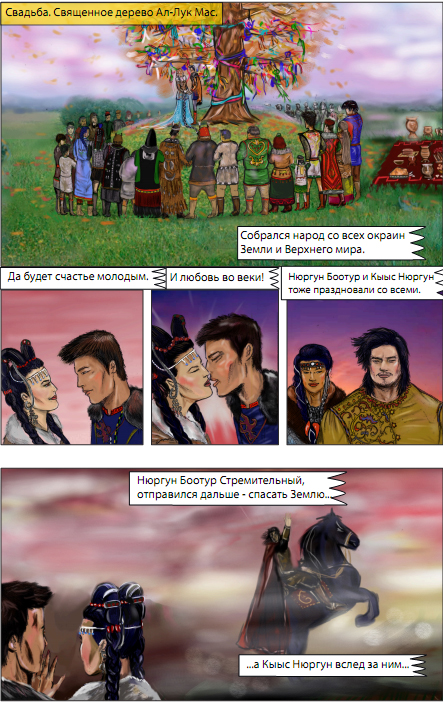
Olonkho introduced in comics format for the first timeIn the 7 October issue of "Ekho stolitsy", an article by journalist Mikhail Gorokhov was published about the work of a beginner artist-illustrator Mariya Chikachyova-Ondar, who in one year independently prepared for publication comics - Olonkho based on the motive of Sakha epic "Nyuryun Bootur the Impetuous".

On top of that, the entire complicated process - from the selection of the subject for the script, sketches, character creation, work-up of the subjects and their number, design, translation to a computer, and coloring, then the page-proofs, which is usually done by 3 - 4 different people, Mariya  did by herself. In Masha's words, her hand is so "charged", that sometimes she can draw on a computer straight out, bypassing the intermediate stages.

Sakha News. Translated by Heda Jindrak
  • 0 comments
  • 100
 
10 October 2011

Tuvan ensemble "Sayany" won the third place at the Cheonan dance festival

Tuvan ensemble "Sayany" won the third place at the Cheonan dance festivalInternational dance festival in Cheonan, South Korea, has finished. According to the results of three stages of the contest,  the ten finalists chosen were: Kosovo, Slovakia, Indonesia, Tuva, Guam, Uzbekistan, Russia (Khabarovsk), Poland, Mexico and Philippines. The first place went to Philippines, second to Uzbekistan, and the third - to Tuva. However, the Tuvan ensemble feels morally the winner: after all, there were teams from 23 countries in the competition!

Congratulations to our artists! 

Info from Tuvgosfilarmonia. Translated by Heda Jindrak
  • 0 comments
  • 0
 
4 October 2011

Hikashu - it means an Elegy

Hikashu - it means an ElegyOn 27 September, at the V. Kok-ool Tuvan Theater of Music and Drama, a meeting took place with the group "Hikashu", meaning "Elegy" in translation. The leader of this Japanese group, Makigami Koichi, has been to Tuva many times, and this time he brought the entire group with him: Sakaide-san, Mita-san, Shimizu-san, Sato-san (Translator's note: Sakaide Masami, Mita Freeman, Shimizu Kazuto, Sato Masaharu respectively).

The meeting was organized by the Center of Tuvan-Japanese friendship "Kargyraa". The Center, opened since march of this year, works closely with Japanese center "Khoomei", headed by Makigami Koichi himself.

"Hikashu" is very popular in Japan, USA, and other countries; right now the group is touring in Russia.

Translated by Heda Jindrak
  • 0 comments
  • 100
 
3 October 2011

International dance Festival in Cheonan (South Korea) gathers speed

International dance Festival in Cheonan (South Korea)  gathers speedThe festival which began on 28 September, is gathering speed: performance after performance, the first stage is finished. Tuvan ensemble "Sayany"  has performed "Dembildei", "Ezir Kara", "Vereteno", "Shaman", and "Naadym". Aside from the contest performances, which brought in about one thousand spectators every day, the festival participants also bring pleasure to their hosts with performances on small stages, "Sayany" with a new number and new costumes every time. During a10-minute show, they presented "Doshpuluurum", "Shaman", and "Oitulaash", and during a15-minute show, "Ezir Kara", "Shaman", "Zvenyashchaya nezhnost" and "Oitulaash".
Tuvgosfilarmonia, Translated by Heda Jindrak
  • 0 comments
  • 80
 
3 October 2011

A Time for Everything: Svetlana Munzuk about her father - Maxim Munzuk Part 4.

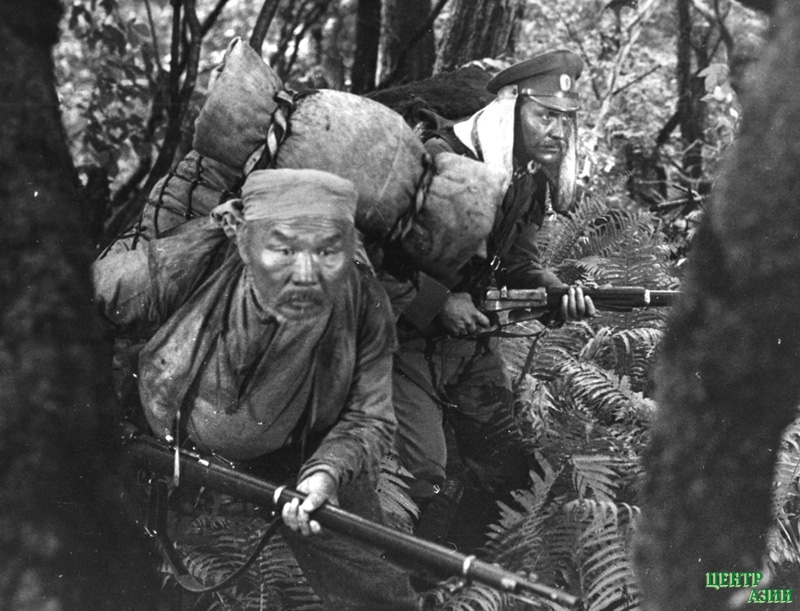
A Time for Everything: Svetlana Munzuk about her father - Maxim Munzuk Part 4. The film "Disappearance of a witness"  turned into a trampoline for Papa that gave him the final boost into cinematographic Olympus. Akira Kurosawa, the director of world-renown, when he saw the movie, cast the Tuvan actor Maxim Munzuk for the title role of his film "Dersu Uzala".

Papa used to tell us that Kurosawa, after reading Vladimir Arseniev's books "Po Ussuriyskomu krayu" (In the Ussuri land) and "Dersu Uzala"  was so absorbed with the image of Dersu, that he simply dreamed about bringing the books to the screen, and he was happy when such an opportunity presented itself.

The filming of the Soviet-Japanese co-production film took place in 1974 in the Ussuri taiga, in the district of  the town of Arsenievo; Maxim Munzuk received the honorary citizenship of this town on 23 October 1975, after the filming was finished.

Center of Asia. Translated by Heda Jindrak
  • 0 comments
  • 100
 
© 2009—2026, Tuva.Asia - portal for tuvinology, «The New Research of Tuva» - electronic magazine . All Rights Reserved.
Established in 2009
Registered as a mass media by the Federal Supervision Agency for Information Technologies and Communications of Russian Federation, certificate Эл №ФС77-37967 issued on November, 5 2009.

If quoted, hyperlink to Tuva.Asia obligatory.

Рейтинг@Mail.ru

География посетителей сайта