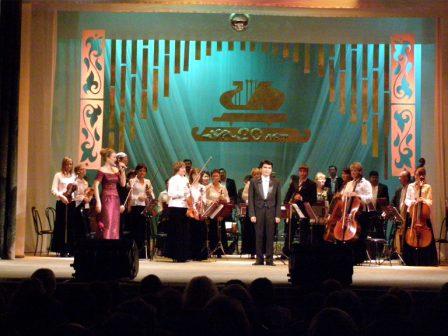
 Practically the entire collective of Khakass Philharmony participated in the program of Days of Khakass Culture in Tuva, where it was associated with the Day of National Unity. Now even many Tuvan children know what a chatkhan is. It is a Khakass musical instrument in the shape of an elongated rectangular box with horse-hair strings stretched length-wise; it is a symbol of the Khakass nation. It was precisely a chatkhan which was used to accompany the heroic epics, “alyptyg nymakhi”. It is believed that chatkhan is an instrument equal in power to the shaman’s drum, and if necessary can be successfully used for the same purpose. Another favorite Khakass instrument, which has not lost its authority to this day, is khomus - a remote relative of Russian balalaika. Just like the chatkhan, it has been known since ancient times: the first mentions of khomus date to the beginning of our era.
Portal for tuvinology
Tuva.Asia / The New Research of Tuva
Russian version/Русская версия
 created with the support of Russian Scientific Fund for the Humanities (grant #09-03-12130в)
Сегодня 19 June 2026 г.