Electronic news magazineRussian version/Русская версия
The new research of Tuva / Новые исследования Тувы
created with the support of Russian Scientific Fund for the Humanities (grant #09-03-12130в)
22 Fabruary 2012
Home | Guestbook | Feedback |
"The New Research of Tuva" magazine. 2011, #4
Journal's archive   > #3, 2010
  > #4, 2010
  > #1, 2011
  > #2-3, 2011
Log in
username
 
password
 
   
register
forgot password?

25 December 2011

Austrian publishers of works about shamanism visited Tuva

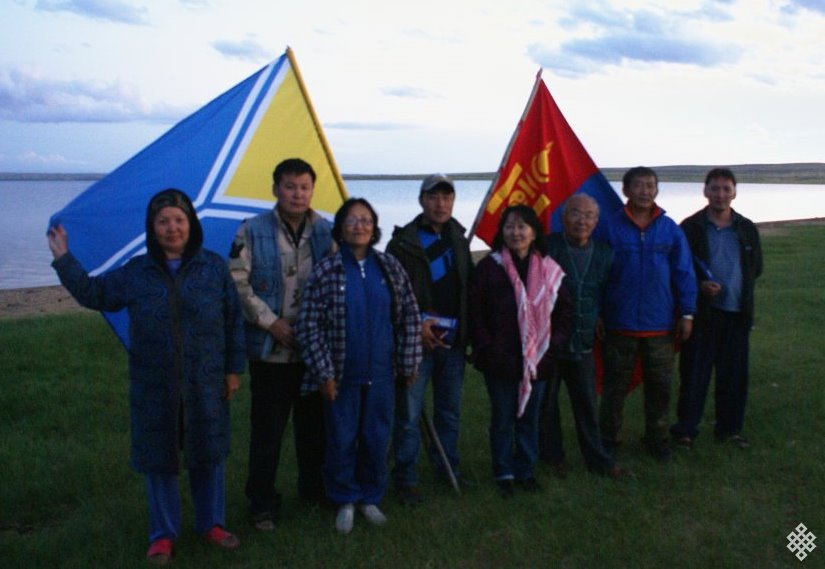
Austrian publishers of works about shamanism visited TuvaThe visitors from Austria stayed in the center of Asia for only five days, and they were saturated! Roswitha-Anna and Paul Uccusic, and Isolda Schmitt managed to do a lot in Tuva. As old friends and acquaintances from 1993 noted, thanks to their visit they found out the news about people who became near and dear to them since the first memorable Tuvan-American scientific- practical seminar of scientists-shamanologists and shamans in that remote June 18 years ago…that is when the first brick was laid of the firm bridge from our republic to Europe for shamans and shamanologists. 
Marina Kenin-Lopsan, Tuvinskaya pravda. Translated by Heda Jindrak
  • 85
24 December 2011

Exhibition "Treasures of Tuva" opened in Sankt-Peterburg

Exhibition "Treasures of Tuva" opened in Sankt-PeterburgAt the headquarters of Russian Geographic Society in Sankt-Peterburg,  the opening of exhibition "Treasures of Tuva" took place, dedicated to 90th anniversary of Tuvan People's republic. It was organized by Russian geographic Society and Institute of history of material culture of Russian Academy of Sciences. Acting for Russian Geographic Society, the vice-president of the Society, head of department of regional economics and nature utilization, department of natural sciences, regional science, information, tourism and mathematical methods of Sankt-Peterburg State University of economy and finance, Vladimir Razumovskiy opened the exhibition. The concept of the exhibition requires knowledge not only of relevant archeological projects on Tuvan territory, but of tradition of archeological research in this area as well. 
Chimiza Lamajaa. Translated by Heda Jindrak
  • 0
22 December 2011

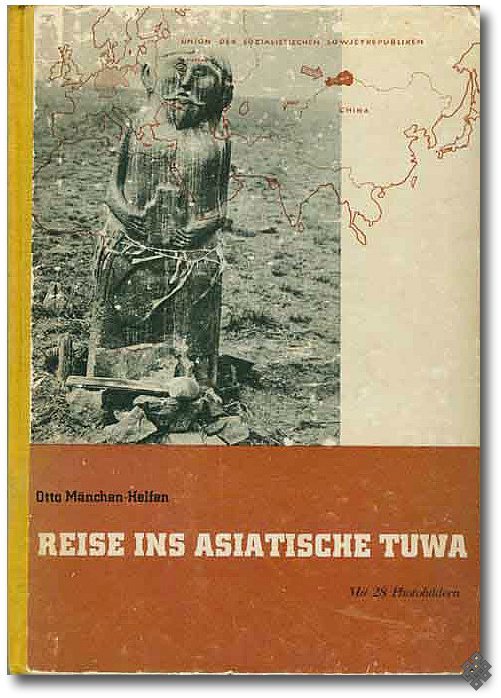
The first edition of Otto Maenchen-Helfen's book "Journey to Asiatic Tuva"

The first edition of Otto Maenchen-Helfen's book "Journey to Asiatic Tuva"Dear friends! Our electronic library has just increased by some unique material - the first edition of  the book by the first traveler in Tuva - Otto Maenchen-Helfen "Journey to Asiatic Tuva" (Berlin, 1931) in German language. As Marina Mongush writes about this work, this book, as well as D. Carruthers' book "Unknown Mongolia" (first volume - "Uriangkhai Krai") remain to this time the most demanded books about Tuva,  which were at one time published in the West (New research of Tuva. 2010, No. 2). In M. V. Mongush's overview, there are these data: Austrian of German extraction O. Maenchen-Helfen was a sinologist by education. He studied at universities in many cities of Europe - including Vienna and Leipzig.  
Editorial Board
  • 85
19 December 2011

Khakass original

Khakass originalJudging by everything, Nikolai Fedorovich Katanov was a really exceptional personality. To this day, he is remembered by Khakass, Bashkir and Tatar people. For the first, he was the first Khakass scholar in history, for the second - he created the "Alphabet of Bashkir language", an as far as the third are concerned, his fundamental pedagogic work took place at Kazan University. There, in Kazan, he also participated for many years in the activities of Sobriety Association. Nikolai Fedorovich Katanov (childhood name - Pora) was born on 6 May 1862 in a steppe place Izyum (Uzyum), 17 km northeast of Askiz of Turakhov ulus (now Askiz district of Republic Khakassia)) on the left bank of Abakan river. His parents belonged to two main tribal subdivisions of  Khakass people: his father was a Sagai, and mother was Kachin. Fedor Semyonovich Katanov ( his Khakass name - Khyzyl Katanov), was a scribe for the ulus. No information was preserved about the mother. 
Argumenty nedeli. Translated by Heda Jindrak
  • 85
17 December 2011

Yakut khomus unites the nations of the world

Yakut khomus unites the nations of the worldIn Yakuts, in an ordinary apartment building, there is a museum of world significance. It is the museum of the khomus - a national musical instrument of the Yakuts. Analogs of this instrument are known to many nations of the world - from Portugal to Papua New Guinea. But a museum of this instrument is only in Russian Yakutia. Correspondent of Pravda.ru visited the museum and talked with its leaders. The excursion for Pravda.ru was kindly led by Elizaveta Varlamova, the head of the scientific section of the museum and khomus-player - improviser. She warned us that the voyage through the world of khomus will be long. 
Pravda.ru. Translated by Heda Jindrak
  • 85
16 December 2011

Tuvan shamans speaking in German

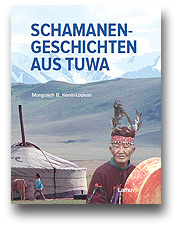
Tuvan shamans speaking in GermanLast Saturday, on 10 December, representatives of Foundation for Shamanic Studies in Europe, Roswitha and Paul Uccusic and translator Isolda Schmitt, arrived to the center of Asia. Even though it is the second time in Tuva for Isolda, it is the sixth time for the Uccusic spouses! True, this is the first time that they made the difficult journey from Vienna to Kyzyl in winter. The program for their visit is very saturated: to see their old friends, to visit with shamans, educators, and students. But the main thing is to tell about Mongush Kenin-Lopsan's book "Myths of Tuvan shamans", which was just published in German language thanks to involvement of these guests of the republic. 
Marina Kenin-Lopsan. Translated by Heda Jindrak
  • 0
15 December 2011

Announcement - Release of New Issue of "New research of Tuva"

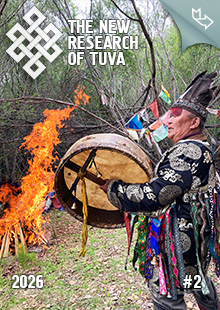
Announcement - Release of New Issue of "New research of Tuva"Dear friends and colleagues! We are happy to inform you about the release of the newest issue of  "New Research of Tuva" journal - No.4 for 2011. The issue, as usual, contains a lot of research material about Tuva and other regions with nomadic culture, brand new articles concerning current research grant projects, as well as those that were already published in print as limited editions. We have new authors - eleven research workers in various fields of scientific and scholarly research (philosophers, historians, lawyers, philologists, geologists).  There are other innovations - new appearance of the issue, which is available for download in the PDF format. The volume of  the current issue in this version consists of 287 pages. We continue to accept materials for the following issue of the journal - No.1 for 2012, which will be released in early March 2012. We are also prepared to accept preliminary announcements of publications, according to agreement with the authors. 
  • 85
14 December 2011

New book by a Tuvan scholar about spiritual-cultural ties of Eurasian nomadism

New book by a Tuvan scholar about spiritual-cultural ties of Eurasian nomadismMoscow publishing house "MOBY Publishing" released a book by Doctor of Historical Sciences, Professor of TuvGU, Nikolai Abayev 'Influence of Tengrianism on ecologic culture and ethnogenesis of Turko-Mongol people of Altai-Baikal region". The book is meant for all who are interested in the history of culture and religion of Turko-Mongol people of Central Asia and Sayan-Altai. New research about spiritual-cultural foundations of Eurasian nomadism is written in a literary language that is sufficiently accessible, and will be interesting not just to scholars specializing in the area of nomadic cultures and comparative religion, but to a wide spectrum of general readers as well. The monograph discusses philosophic-methodological aspects of study of Tengrian civilization in the light of  the theory of  auto-organization and social synergetics, it investigates problems of influence of Tengrianism on ethno-culturogenesis of Turko-Mongol people of Central Asia and Sayan-Altai region,  on formation and evolution of  ecological culture in "nomadic" civilization. 
Alexander Filatenko. Translated by Heda Jindrak
  • 85
9 December 2011

TIGI Expedition to Mongolia and China

TIGI Expedition to Mongolia and ChinaChina and Mongolia have become the location for field research of a group of scientists from TIGI, in the framework of the project: "Tuvans of Tsengel: folklore and literature" (2002-2011). International folklore-ethnographic expedition to Xinjiang- Uighur autonomous region of  people's Republic of China and Kobdo aimak of Mongolia of  TIGI scientists U.A. Dongak, Z.B. Samdan, B. Bayarsaikhan and doctor G. Zolbayar (Bayan-Ulegei institute of sociologic research of Mongolian AN) is a continuation of this scientific project which began in 2002 at TIGI as "Tuvans of Altai: folklore and literature", in cooperation with Bayan-Ulegei science center for sociological research of AN of Mongolia. In 2006-2007, the work was performed with support of RGNF grant. 
Uran Dongak, TIGI. Translated by Heda Jindrak
  • 85
Locations of visitors to this page