Many colors of faith in Tuva
22 Fabruary 2011.
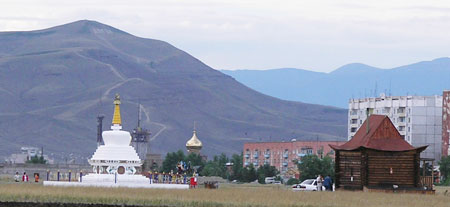 If you walk out of the gate of the Holy Trinity church in Kyzyl and walk down the street, towards the Yenisei, soon you will be at the doorstep of the "cabin" of the oldest shaman of Tuva. The street on which you can complete the journey from shamanism to Orthodox Christianity and back in ten minutes carries the name Komsomolskaya. A well-known picture, isn't it? Gods, values, ideals - everything mixed together in the make-up of a contemporary person…
The Kam knows everything
The senior shaman Mongush Kenin-Lopsan is an amazing person. Just the list of his titles can throw a resident of European Russia into confusion. Doctor of historical sciences, Merited worker of culture, awarded the Order of Friendship of Nations and a medal "For merit for homeland" a member of the Writers' Union of Russia, carrier of the title "Living Treasure of Shamanism", supreme President-for -life of all Tuvan shamans… Visitors are waiting on the small porch of his "cabin" to be admitted. Their faces are serious, showing concern and humility. Women and men, young and old, they are thirsting to find out about their future, hoping for healing from disease, seeking answers to all possible 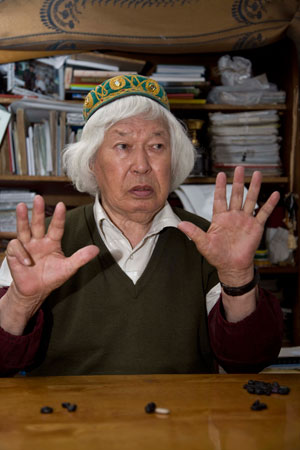 questions. Should I go to Abakan tomorrow? Should I quit my job? Should I get married or not, and if yes, then precisely in which month and on what day? Should I take a loan? What name should we give our baby? How to cure my husband from drinking?
It is not out of place to note that this "cabin" is one of buildings of the National Museum of Republic Tuva, where Mongush Kenin-Lopsan is a senior scientific worker.
A real scholar and scientist. A real poet. And a real shaman as well - hereditary, powerful, majestic. Such a combination of qualities, I dare say, is possible only in Tuva.
What is shamanism in contemporary Tuva? It is a cultural tradition, with roots reaching deep to ancient eras. And it is an indelible component of daily life. Who is a shaman (kam)? It is a person who has the ability to enter into spheres of existence which are unreachable to other people.
What does a shaman do? He contacts spirits who inhabit the celestial, earthly and underworld realms. He can bargain with them, he can bring them, he can fight with them and chase them away. There are tree types of activity for these purposes: healing, divination, and "kamlanie". Healing includes elements of traditional folk medicine. Divination is performed with the use of pebbles, bones, and sheep scapula (shoulder blade). Kamlanie is a powerful activity with singing, dance and drumming, which demands complete self-abnegation and entry into a trance state, which can terminate in loss of consciousness or even death.
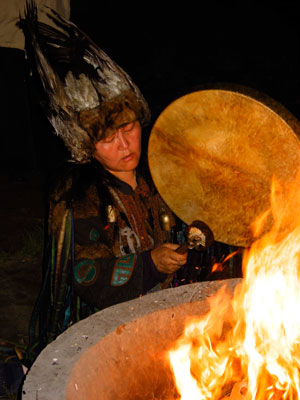 Who comes to consult a shaman? Mostly Tuvans, but it is not rare for Russians to seek a consultation. Education, sex and age have no significance. I do not know anybody among Tuvans who has not consulted a shaman even if rarely, and they all recognize the shaman's real power.
When do they consult a shaman? Basically in any uncomfortable or incomprehensible life situation. My friend's father died. A death of someone close is a definite indication to call a shaman. The Kam advised: "You were born in the Year of the Black Dog, that means that this year you can't go to memorial services, or you'll die." It has to be noted that memorial services in Tuva last for many days and participation of all the relatives, even the most distant ones, is mandatory. For a son of the deceased to be absent is unheard of. But nobody condemned him for it, because the shaman ordered it.
There were rumors that the shamaness Ai-Churek, who died last November and was famous throughout Tuva as well as abroad, was performing a "kamlanie" for the head of the government of republic Tuva on a weekly basis. So what could be said about the lower-ranking officials.
Borderline between the worlds
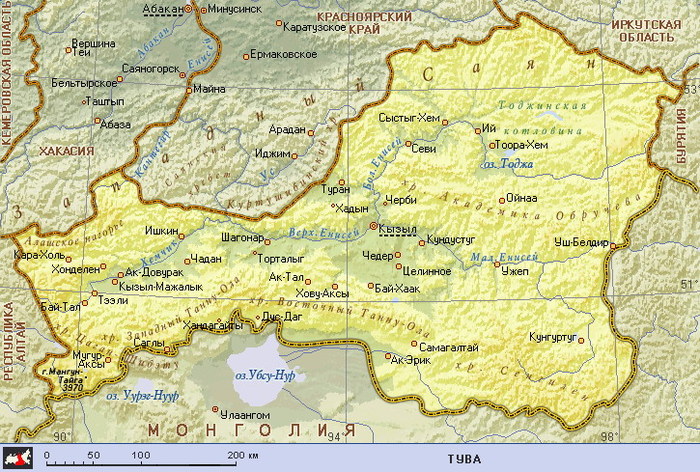 Tuva is a country where incompatible elements combine. It is located in the geographic center of Asia, between the mountain ridges of the Sayans and Tannu-Ola, on the border between Russia and Mongolia. It is a borderline between two worlds: the empire of Vladimir The Red Sun, and the Empire of Genghis-Khan. Tuva was the last to enter into the system of Russian State, in 1944, and still remains one of the least accessible and most isolated regions of our country. That is why this is the place where millennia-old foundations of nomadic way of life and elements of ancient cultural traditions of Central Asia have been preserved better than anywhere else within the Russian Empire or USSR. For two centuries, Tuva was under the domination of Chinese - Manchurian empire Chin, and absorbed significant influences from our south-east neighbor. And because of its remoteness, it became for a time the goal of migrations of Russian Old Believers.
As a result, contemporary Tuva is a zone of contact and mutual influence of four types of religious world-views, mentalities, and spiritual practices. To say it simply - four faiths. Corresponding to the old Central Asian practice, these four faiths can be designated by four colors.
'Black faith" (and there is no negative meaning in "black"), that is shamanism. It is the inheritance of ancient spiritual and cultural traditions.
"Yellow faith" - lamaism, or rather Tibetan-Mongolian Buddhism, which was actively disseminated during the time of Chin rule.
"White faith" - Orthodox Christianity, which was brought by Russian settlers at the end of 19th - early 20th centuries.
And then there are the Old Believers, whom we, based on their un-humble, protest character, will call "Red faith".
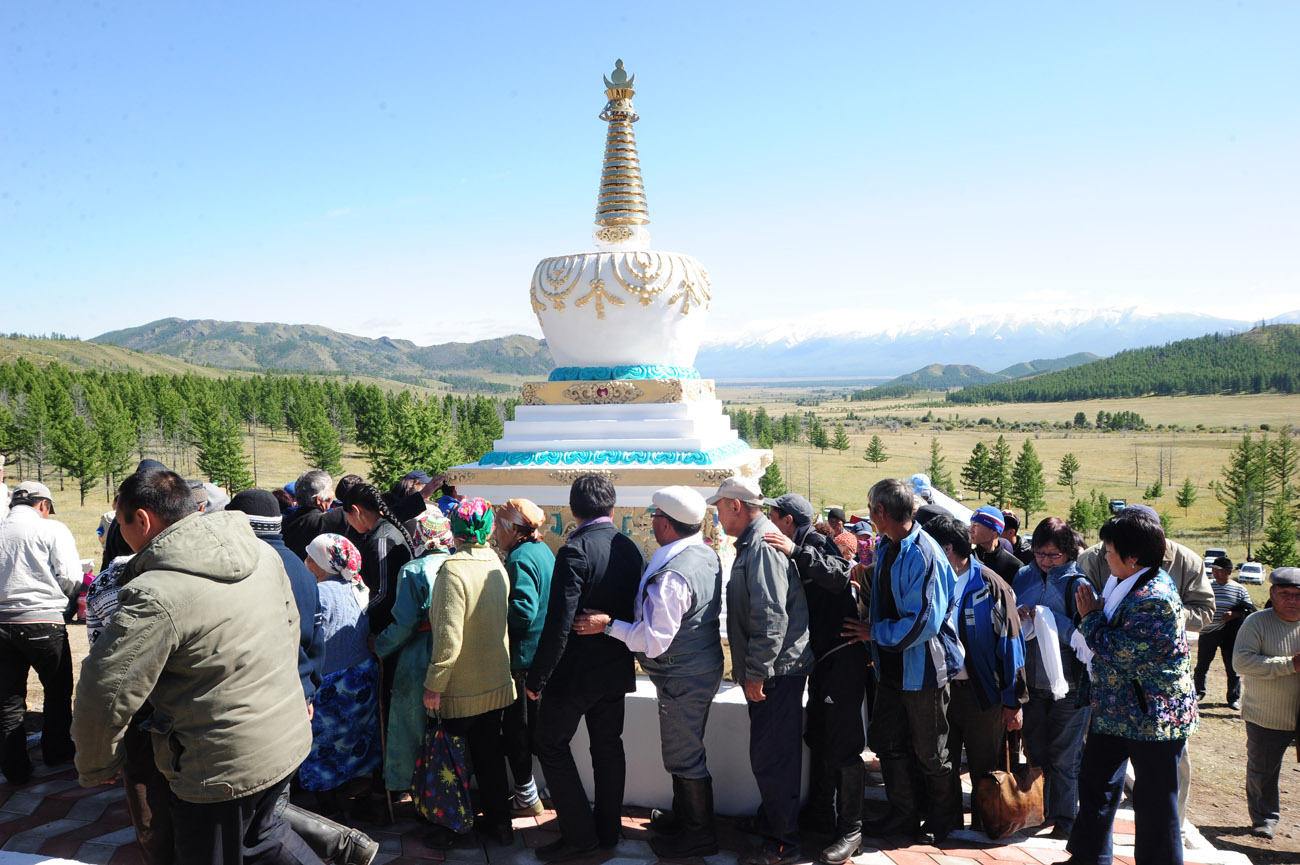 The Old Believers, already a hundred years ago, have taken over a small foothold, which has been stable until now. They live concentrated in several villages near the source of Big and Small Yenisei. Even now it is difficult to get there. They do not shun the world and other people, but they do not mix with them. Their distinguishing characteristics are beards for the men, and head scarves and long dresses for the women. Their spiritual life is kept hidden from strangers. They keep aloof but equal relationships with representatives of other faiths.
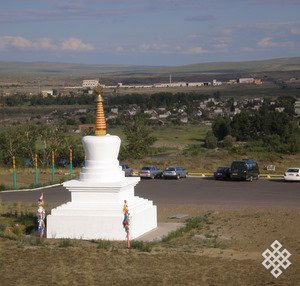
"Yellow faith" seemed to be extirpated during the Soviet times, but it has now great success in Tuva. New lamaist temples "khuree" are being built, and the numbers of monks-lamas is growing; many suburgans - places of worship of spirits and deities are being built.
"Black faith", which has absorbed elements of ancient Iranian Mithraism, ancient Turkic Tengrianism, ancient Tibetan religion Bon, and a multitude of local cults, is the most popular, and at the same time the most elitist phenomenon of spiritual life in Central Asia. Only the shamans themselves, who hand down the secret knowledge form teacher to a disciple, from century to century, can be considered its real adepts and keepers. In all of Tuva there are a few dozen of them. Or hundreds. There are no exact numbers, because there are no definite criteria: who is a shaman, and who is not a shaman. There are six active shamanic associations in Tuva. But there are also lone shamans. Or, more exactly, any shaman is in nature a lone shaman, because the membership in an association is only a means of systematizing and facilitating the earnings. (The first thing that a visitor sees on ascending the creaky stairs to the little porch of the shamanic association, is the fee schedule. So much for divination, "kamlanie" at the site is so much, and so on…) it is precisely shamanism that attracts practically all the Tuvan and some of the Russian population of Tuva. And it is the basic religious consciousness of the Tuvans.
"White" minority
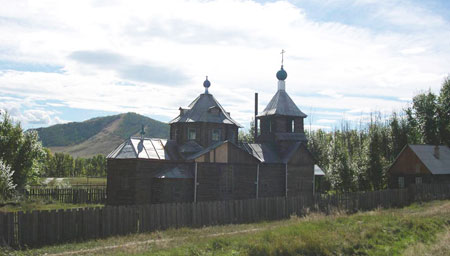 Russian Orthodoxy is still the plant with weakest roots on the spiritual soil of Tuva. In the republic with a population over three hundred thousand, there are only three Orthodox churches, and four clergymen. The entire Kyzyl, capital of Tuva, where almost half of the population of the republic lives, has only one single parish and one church -Trinity. A tiny, old, wooden one. It is characteristic that the majority of its members do not even know that it is called Trinity. They simply call it the Church - and that is it. "Where do you live?" - "On the hill, by the church." It is true that a new large church is under construction, even the dome has been gilded. But it has been under construction fort eh past ten years, and there is no end in sight.
The Orthodox Christians are mostly Russians. It is very difficult to tell just how many there are. On one hand, for the Russians, who are an ethnic minority in Tuva (about 15%), the orthodox religion is a symbol of unity and ethnic self-identification. On the other hand, the main bulk of the Russians is not educated in religion, disoriented, and bereft of traditions. That is why the church in Turan, the most "Russian" settled area in Tuva, the church can barely make ends meet. The priest, a young, poorly dressed "Father" drives a tiny ancient "Oka", and he spends more time repairing the rusty wreck than driving it.
There are only very few Orthodox Christians among the native Tuvans. There are two main obstacles to dissemination of Orthodoxy among the Tuvans. The first obstacle is the family - clan close structure of Tuvan society. Each Tuvan is related to innumerable relatives, a member of a clan. Hundreds of Tuvans have , for example, the family name Oyun, and all of them are potential relatives. No less widespread is the family name Salchak, and the Salchak clan is related to the Oyuns… and the clan - it is not just genes. Genes are really not all that important, because Tuvans never made any difference between their own children and adopted ones, or between legitimate and illegitimate ones. The family - that means, first of all, customs, traditions, family holidays and celebrations, cults, spirits of the ancestors. And where there are spirits, there you have shamanic rituals. To convert to Orthodox Christianity would lead to total disruption of family ties, which would be unthinkable for the majority of Tuvans.
The second factor is the not very kind attitude that the religious community takes towards new converts. Unfortunately, there is a simple criterion at work: the shape of the eyes and width of the cheek bones. One completely russified Tuvan woman friend complained to me that old women of the religious community accosted her. Hey, you, slanty-eyes, what are you doing here! Go to your shamans. My friend probably exaggerated a little bit, but knowing the church-goers, it is at the very least plausible.
Each spirit gets his earrings
 The expressions of Orthodox intolerance are especially painful to Tuvans because any kind of religious intolerance if totally foreign to them. On the contrary: a Tuvan is inclined to fear and respect any kind of supernatural power, known or unknown. If it was possible to build an altar to "An Unknown God", mentioned by the Apostle Paul, it would be in Tuva.
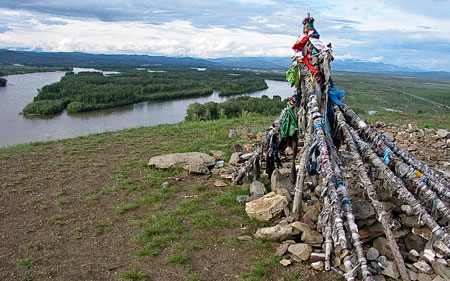
On the roadways in Tuva, on mountain passes, there are usually Buddhist suburgans. And definitely - there is always a structure of poles and stones, called an ovaa, a dwelling of shamanist spirits. Tuvans, and, as a matter of fact, many Russians, stopping at the mountain passes, always leave some candies and sprinkle vodka to all directions, so that the shamanist spirits would not get offended.
My friend - a Tuvan woman, daughter of professors, answers the question of her religious faith by "I am a Buddhist." At the same time she frequents shamans and has a great respect for Orthodox clergy. At the funeral of her husband, there were a shaman , a lama, and an Orthodox priest was not there only because the deceased had no relationship to the Orthodox church. - who came to live in Peterburg for six months, soon started to give his Peterburg friends greetings for the Orthodox church holidays. At the same time it often happened that his Peterburg friends, busy with their work, only found out form him that it was Tatiana's Day or other Orthodox holiday. I became interested: you visit shamans, so why do you observe Orthodox holidays? The sense of the answer was approximately this: I am in the land of the Orthodox Christians, that means, I should respect the spirits who rule here. So much more, because the supreme spirit, it seems, is omnipotent.
Russians who have lived in Tuva for a long time develop the same frame of mind.
 When you examine3 it, it is not really religious tolerance, but a readiness - almost childish, naïve - to respect any manifestation of a great power ruling the world. Shamanism anticipates the One God. One of the appellations of the supreme deity in the algyshes (shamanist psalms) of Tuvan shamans is Korbustu. This word, most probably, comes from the name of the ancient Iranian Creator deity Hormuzd (Ahura Mazda- translator note- HJ), which translates to Russian as The Supreme. Whatever a shaman does is not against God, but…how would you say it? Not knowing God, they anticipate Him. A shaman dances and drums on the threshold of the Temple.
Return